
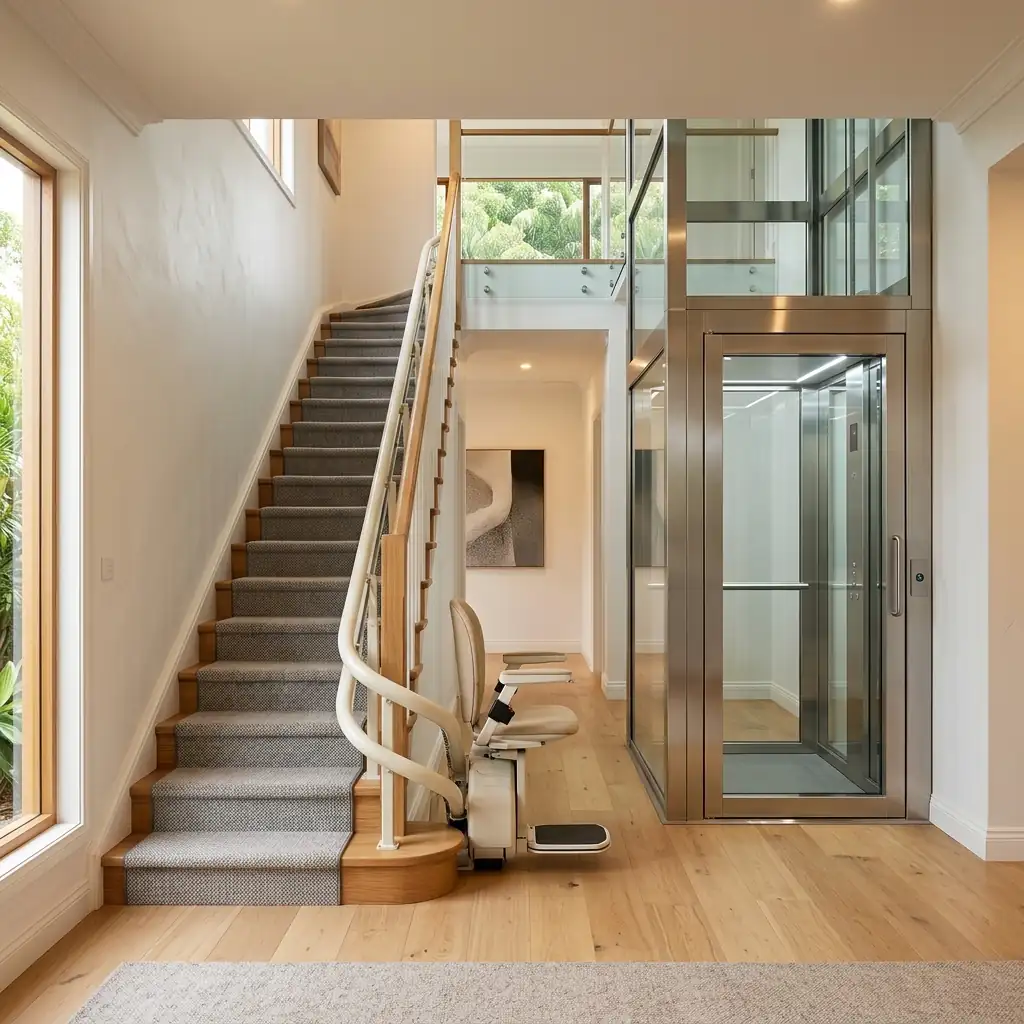
Introduction: Two Solutions, Very Different Outcomes
When mobility becomes a challenge in a multi-storey home, two products consistently come up in conversation: the stairlift and the home lift. On the surface, both solve the same problem - getting from one floor to another safely. But beyond that basic similarity, they are fundamentally different products with very different implications for your home, your lifestyle, your budget, and your property's future value.
The choice between the two is one that many Australian homeowners make without fully understanding the trade-offs. A stairlift is cheaper upfront, but it may not serve your needs in five years. A home lift costs more, but it adds real asset value to your property and accommodates virtually every mobility scenario - including wheelchair access. This guide cuts through the confusion so you can make the right decision for your specific circumstances.
Key Takeaways
- Stairlifts Are Lower Cost, But Limited: Stairlifts are typically 60–75% cheaper to purchase and install than a home lift, but they cannot accommodate wheelchairs and do not add measurable value to your property.
- Home Lifts Are a Long-Term Asset: A properly installed home lift increases property value, appeals to future buyers, and accommodates all mobility levels - including full wheelchair use.
- Staircase Shape Matters: Curved or spiral staircases require custom-built stairlifts that can cost nearly as much as an entry-level home lift - often making the lift the smarter financial choice.
- Stairlifts Are Not Invisible: A stairlift rail permanently occupies your staircase, reducing usable width and altering the aesthetic of your home. A well-designed home lift can be a striking architectural feature.
- Planning Ahead Changes the Maths: If you are building or renovating, including a lift void at construction costs very little - making a future home lift far cheaper than a reactive stairlift installation.
Understanding Each Option
What Is a Stairlift?
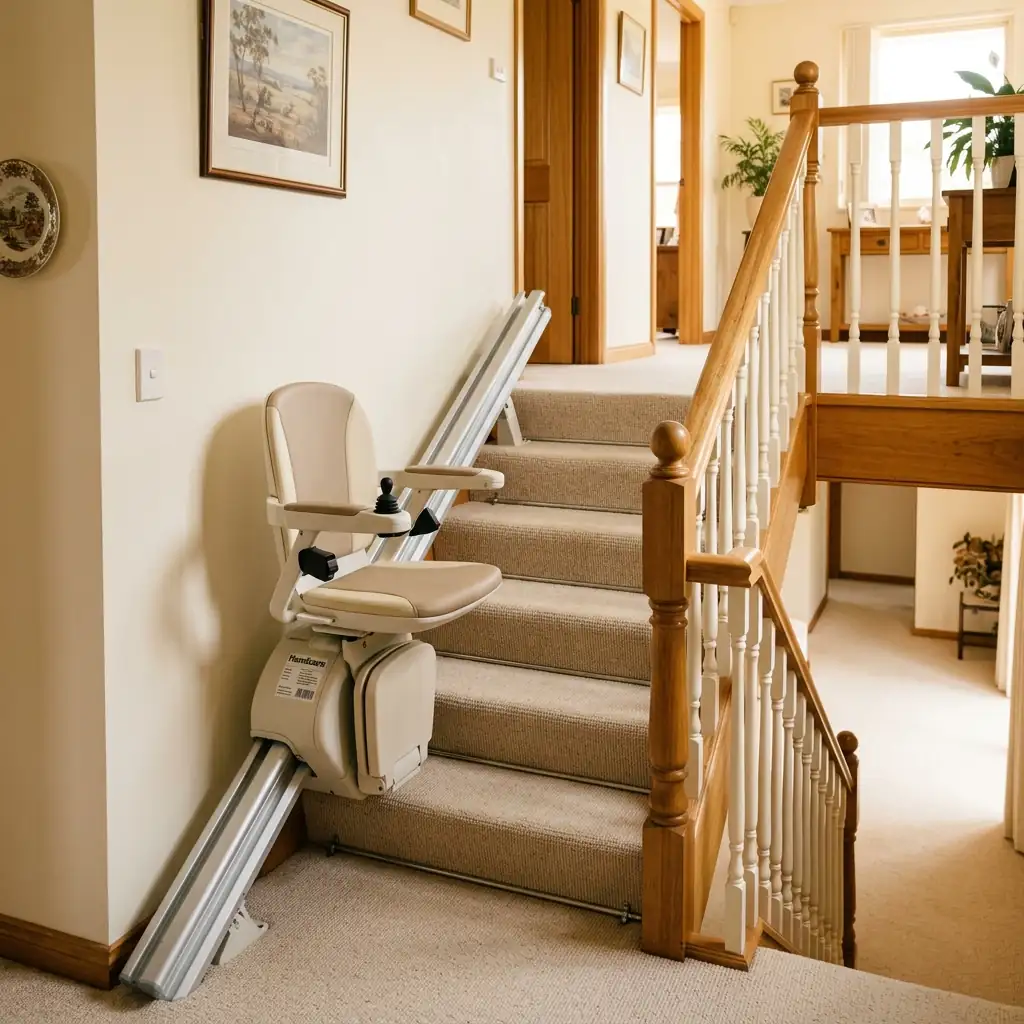
A stairlift is a motorised chair or platform that travels along a rail fixed to the surface of your staircase. The user sits in the chair (or stands on the platform, for standing models), presses a button, and is carried up or down the staircase. Stairlifts are available for straight staircases (the most affordable option) and curved or spiral staircases (custom-built, significantly more expensive). They require no structural modifications to your home beyond anchoring the rail to the stair treads.
What Is a Home Lift?
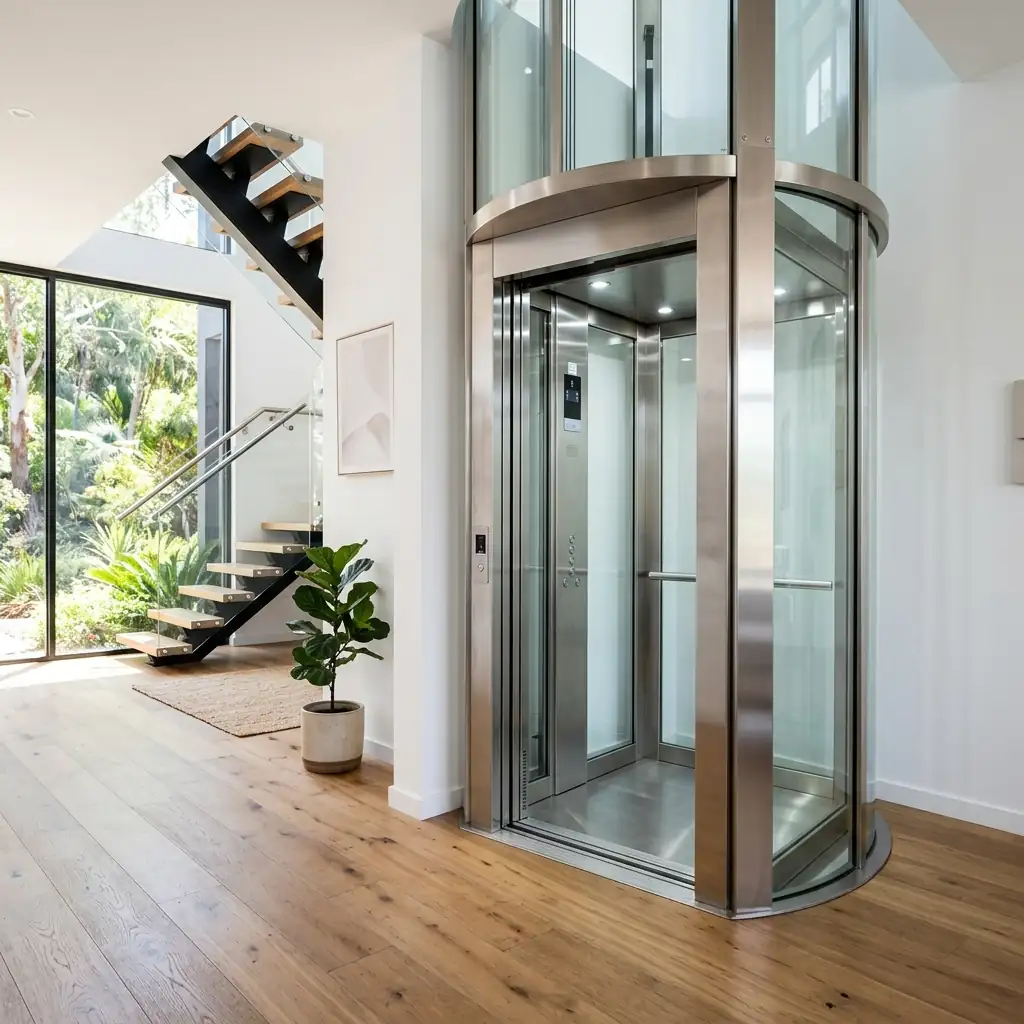
A home lift (also called a residential elevator or domestic lift) is a fully enclosed cabin that travels vertically between floors inside a dedicated shaft. Unlike a stairlift, the lift operates independently of your staircase - it moves through the floor structure, connecting floors with a true vertical journey. Home lifts in Australia come in hydraulic, traction, pneumatic, and screw-drive variants - our complete buying guide breaks down how each one works, including space requirements, ride quality, and cost profiles. They require a structural void or shaft and typically involve a builder, an electrician, and a licensed lift installer.
Head-to-Head Comparison
1. Cost
Cost is often the first - and sometimes only - factor homeowners consider. But the true financial picture is more nuanced than the purchase price alone.
Stairlift costs in Australia typically range from $10,000 to $20,000 for a straight staircase unit, fully installed. A curved stairlift is custom-manufactured and can range from $15,000 to $35,000 or more, depending on the complexity of the curve. Rental options are also available from some providers for those with short-term needs (e.g. post-surgery recovery).
Home lift costs are higher, with a realistic total project cost ranging from $28,000 to $80,000+ depending on the lift type, the extent of building works required, and the degree of aesthetic customisation. However, a home lift is a permanent, capital-appreciating asset; a stairlift is not.
2. Space Requirements
A stairlift rail is fixed directly to your staircase treads and permanently narrows the usable width of your staircase. This can make it difficult for two people to pass on the stairs simultaneously and may restrict the movement of furniture, prams, or emergency services equipment. On narrow staircases (less than 700mm clear width), a stairlift may not be practical at all.
A home lift, by contrast, operates entirely outside your staircase. It requires its own footprint - typically between 0.9m² and 1.5m² - but leaves your staircase completely clear. Modern compact lifts, including pneumatic and screw-drive models, have a surprisingly small footprint and can often be installed in the corner of a room, inside a converted closet stack, or in the well of a winding staircase. For a real-world look at how retrofit lifts fit into existing homes, see our retrofit installation guide.
3. Wheelchair Accessibility
This is perhaps the most critical distinction between the two products. Standard stairlifts cannot accommodate a wheelchair. The user must be able to transfer from their wheelchair to the stairlift chair at the bottom of the stairs, travel up, and then transfer back to a waiting wheelchair at the top - a process that requires significant upper body strength, balance, and a second wheelchair on each level.
A home lift can be fully wheelchair accessible. Lifts built to Australian Standard AS 1735.12 have a minimum platform size of 800mm × 1200mm for a lone residential user in a Type A wheelchair, with automatic sliding doors wide enough to accommodate wheelchairs. For anyone who uses - or anticipates using - a wheelchair, a home lift is the only practical long-term solution.
AS 1735.12 - Minimum Platform Dimensions
| Principal Use | Minimum Dimensions (W × L) | Minimum Rated Load |
|---|---|---|
| Type A and B wheelchairs with an attendant and adjacent entrances | 1,100mm × 1,400mm | 385 kg |
| Type A and B wheelchairs with an attendant | 900mm × 1,400mm | 315 kg |
| Lone user, either standing or in a Type A wheelchair | 800mm × 1,250mm | 250 kg |
For a deeper look at cabin sizing, door types, and what to specify for wheelchair-accessible models, see our complete home lift buying guide.
4. Property Value & Resale Appeal
A stairlift adds little or no value to your property. In fact, some real estate agents report that stairlifts can slightly deter younger buyers who see them as a signal that the home requires extensive accessibility modifications. They are typically removed when the property is sold.
A well-installed home lift, by contrast, is widely regarded as a premium feature that increases a property's market appeal and resale value - particularly as Australia's population ages and multi-storey townhouse living becomes more common. In competitive urban markets, a home with a lift commands a meaningful premium over an equivalent home without one, particularly among affluent downsizers and buyers planning for long-term accessibility.
5. Aesthetics
Stairlifts are functional but rarely beautiful. The rail, chair, and mechanical components are always visible on the staircase and are difficult to conceal or integrate into a home's design aesthetic. For homeowners who have invested in quality interiors, this can be a significant drawback.
Home lifts, particularly glass-panelled and pneumatic models, can be genuine architectural statements. Many homeowners choose to make their lift a design feature - a glass shaft rising through the centre of an open-plan home, illuminated internally, becomes a focal point rather than a medical afterthought. Some even install external lift towers that double as striking architectural elements.
6. Operation & User Control
An often-overlooked difference between stairlifts and home lifts is how they are operated during travel. Under Australian Standards, stairlifts require the user to hold down the control button at all times while the lift is in motion. If the button is released, the stairlift stops immediately. This "hold-to-run" requirement is a safety feature mandated by the standards, but it means the user must maintain constant hand pressure throughout the entire journey - which can be uncomfortable or difficult for those with limited grip strength or dexterity.
Home lifts installed within a shaft, by contrast, use one-touch automatic controls. The user presses a button once and the lift travels to the selected floor without any further input required. This provides a significantly more comfortable and effortless experience, particularly for elderly users or those with upper-limb limitations.
It is worth noting that shaftless home lifts (those without a fully enclosed shaft) are also subject to the hold-to-run requirement under Australian Standards, similar to stairlifts. If hands-free operation is important to you, a shaft-enclosed home lift is the best option.
Comparison at a Glance
| Feature | Chair Stairlift | Home Lift |
|---|---|---|
| Purchase Price | $8,000 – $25,000 | $28,000 – $80,000+ |
| Adds Home Value? | No - considered a temporary medical fixture | Yes - permanent capital asset |
| Serves Multiple Floors? | Yes (depending on staircase configuration) | Yes - up to 4+ floors |
| Independent Use? | No - must walk to stairs | Yes - door to door, floor to floor |
| Suitable for Wheelchairs? | Generally No | Yes (dependant on size) |
| Lifespan | 10-15 years | 20 – 30+ years |
| Aesthetics | Completely exposed and visible in full view on the stairway | Integrated seamless look |
For those exploring whether government funding may help, our detailed guide to grants and subsidies for home lifts covers NDIS, DVA, state-based programs, and GST exemptions in full. And if you want to understand where the costs actually go, our complete buying guide breaks down the full project budget - from the lift unit to shaft construction, electrical work, and council approvals.
When a Stairlift Is the Right Choice
A stairlift may be the most sensible solution in the following circumstances:
- Short-term or temporary needs: If your mobility challenge is the result of a temporary injury or post-surgical recovery, a rental stairlift is a cost-effective bridge solution.
- Budget is the primary constraint: If the upfront cost of a home lift is genuinely out of reach and no government funding applies to your situation, a straight-staircase stairlift can provide meaningful relief at a fraction of the cost.
- The home is being sold soon: If you plan to sell the property within two to three years and simply need to remain safe in the home until then, a stairlift can be a pragmatic short-term measure.
- No structural space is available: In some very old or unusually constructed homes, there may be genuinely no viable location to install a lift shaft. However, before ruling it out, we recommend exploring the possibilities in our guide to installing a lift in an existing house - many homeowners discover more options than they initially expected.
When a Home Lift Is the Right Choice
A home lift is almost always the superior long-term investment in the following situations:
- Wheelchair use is current or anticipated: If there is any chance that a wheelchair will be required in the future, a home lift is the only product that will remain functional for the full spectrum of mobility needs.
- You intend to stay in the home long-term: A home lift pays for itself over time through preserved independence, avoided relocation costs, and added property value. The longer you stay, the better the return.
- The staircase is curved or spiral: A custom curved stairlift can easily cost $15,000–$35,000 - often placing a compact entry-level home lift within the same price range. At that point, the home lift is clearly the better investment.
- Aesthetics and resale value matter: If you have invested in a quality home and care about how it presents to the market, a stylish home lift is a far more desirable asset than a stairlift rail on your staircase.
- You are building or renovating now: Including a structural lift void during construction adds as little as $2,000–$5,000 to the build cost. This makes a future home lift significantly cheaper to install and is a wise investment for any multi-storey home. Our retrofit installation guide covers the building work involved in detail.
Cases Where a Stairlift Simply Will Not Work
There are specific scenarios where a stairlift is not a viable solution at all, regardless of budget:
- The homeowner is a full-time wheelchair user and cannot safely transfer to a chair at the base of the stairs.
- The staircase is too narrow (less than 600mm usable width) to safely accommodate a stairlift rail while still allowing emergency egress.
- The home has three or more storeys and a single stairlift cannot serve all levels without requiring multiple transfers - a home lift serves all floors in a single journey.
- Another person in the household needs to use the staircase freely at the same time, which a stairlift rail physically prevents.
Not Sure Which Is Right for You?
Answer a few simple questions about your home and needs. We'll match you with qualified local suppliers who can assess your specific situation and provide up to 3 free, no-obligation quotes.
Get 3 Free QuotesConclusion
For most Australian homeowners facing a long-term mobility challenge, a home lift is the more future-proof, financially sound, and lifestyle-preserving choice. A stairlift is a pragmatic solution for specific short-term or budget-constrained situations, but it comes with real limitations - particularly around wheelchair access, staircase impact, and property value - that can make it an expensive compromise in the long run.
The most important step is getting qualified, impartial advice specific to your home and circumstances. No two properties are identical, and what works beautifully in one home may not be feasible in another. Compare quotes from multiple licensed suppliers before committing to either solution.
Depending on where you are in your decision process, our other guides can help you go deeper:
- Choosing between a stairlift and a lift? You are reading it right now.
- Ready to research lift types, costs, and safety features? Start with our complete home lift buying guide.
- Wondering if your existing home can accommodate a lift? Our retrofit installation guide covers location options, building work, and timelines.
- Exploring funding? Our grants and subsidies guide covers NDIS, DVA, state programs, and GST exemptions.